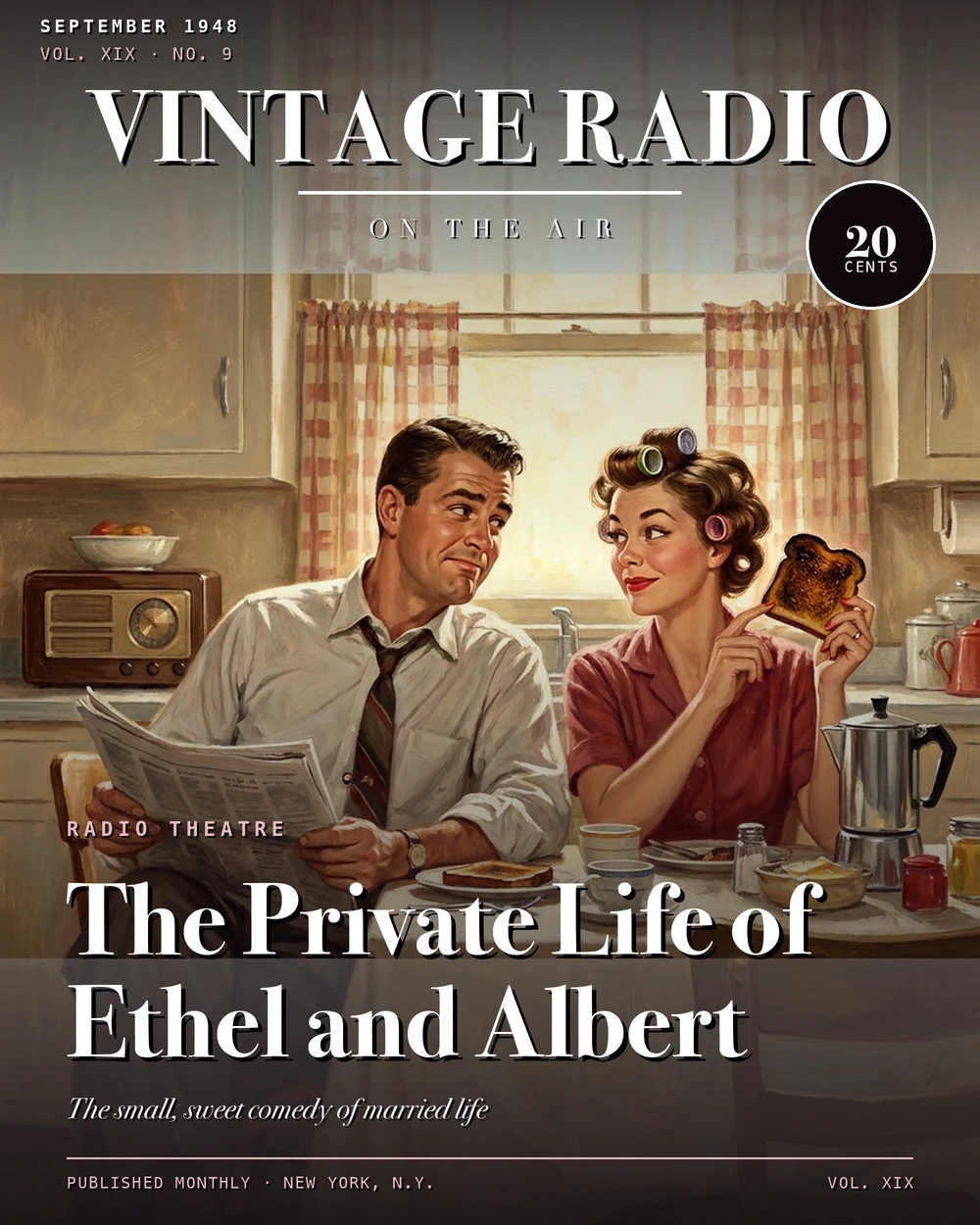
The Private Life of Ethel and Albert
How It Got on the Air
Peg Lynch — born Margaret Frances Lynch in Lincoln, Nebraska, on November 25, 1916 — started writing about Ethel and Albert long before anyone in New York had heard of them. Her father died when she was two, and her mother moved the family to Kasson, Minnesota, where she worked as an orthopedic nurse at the Mayo Clinic. As a teenager, Lynch helped out at KROC radio in Rochester, a station belonging to a classmate's father, and used the access well: she interviewed celebrities passing through the Clinic, including Lou Gehrig, Jeanette MacDonald, Knute Rockne, and Ernest Hemingway. By the time she graduated from the University of Minnesota in 1937 with a degree in English, she had a clear sense of what she wanted to do with radio.
She started working in radio in 1938 at a Minnesota station and eventually landed at KATE in Albert Lea, where she developed the Ethel and Albert characters. At KATE she worked under the pseudonym "Lynn Fairbanks" — the first name to avoid confusion with another Peg at the station, the second a family name on her father's side — and played Ethel opposite a station announcer named George Russell as Albert. The format began partly as a practical commercial device: Lynch found that a husband-and-wife setup could be adapted to sell a variety of products. But she quickly discovered it was also just good drama.
After four months at KATE, Lynch moved to WCHV in Charlottesville, Virginia, taking Russell along, and later to WTBO in Cumberland, Maryland, in 1941. At WTBO, the show expanded to five evenings a week at fifteen minutes an episode, and it reportedly became popular enough that people could hear it playing through open windows as they walked down the street. It was at WTBO that Willis Conover — later famous as the Voice of America's jazz broadcaster — played Albert. In February 1944, Lynch arrived in New York City with roughly $500 and took an apartment near Gramercy Park in a building where many actors lived.
She was hired to write for a network serial almost immediately, and while doing that work, she submitted Ethel and Albert scripts to the Blue Network. NBC had also expressed interest, but Lynch refused their offer because it would have required her to give up ownership of the show. The Blue Network, recently purchased by Edward John Noble, wanted a daytime comedy that was self-contained per episode rather than a continuing soap opera — Ethel and Albert fit perfectly — and they agreed to let Lynch keep the rights. That ownership decision would shape the show's entire history.
The Show Itself
The series premiered on the Blue Network on May 29, 1944, airing in fifteen-minute weekday installments. The announcer opened each episode with the same line: "The big events in one's life occur only now and then, but there are smaller events that are familiar to every family — it's these daily incidents that make up the private lives of Ethel and Albert." That was the honest description of the show's entire method. Ethel and Albert Arbuckle were a young married couple in the fictional small town of Sandy Harbor, and the comedy came entirely from the small textures of their shared life. Albert managed an office in town. Ethel ran the household. Entire episodes could be built around the couple doing dishes at the kitchen sink.
The humor was genuinely low-key in a way that set the show apart from the broader comedy of the era. An episode might center on Ethel disputing Albert's claim that he could see her using only his peripheral vision. Another involved Albert fretting over a cigarette case he'd bought his brother-in-law for Christmas, exchanging it, and then learning the brother-in-law had quit smoking. One installment hinged entirely on efforts to open a pickle jar. Ethel once placed a five-dollar bet with a neighboring housewife on a heavyweight championship fight in an attempt to cancel out a bet Albert had made with the neighbor's husband. Nothing bigger than that.
Lynch told critic Leonard Maltin: "I realized that I didn't have to sit down and knock myself out every minute to try to think of something funny. All I had to do was look around me." As Paul Rhymer did with Vic and Sade, Lynch populated Sandy Harbor by having her two main characters talk about their neighbors and friends rather than actually bringing those people on air. The town felt full without ever being heard. The daughter, Suzy — played by Madeleine Pierce — wasn't born until the show's third year, and when she arrived, hers became only the third voice the series had ever used. Music was provided on organ by Rosa Rio and others, with themes including "Love Nest," "Side by Side," and "There's No Place Like Home." George Ansbro and Glenn Riggs served as announcers at various points, with Robert Cotton directing the quarter-hour episodes and William D. Hamilton taking over from 1949 to 1950.
Lynch told Newsweek that when she first wrote Ethel, the character was quite foolish — she cited an example of Ethel buying multiple grand pianos. By the time the show reached the Blue Network, Lynch had made Ethel considerably wiser, and the dynamic between the two became something closer to genuine mutual domesticity than comic misunderstanding. Radio historian Gerald Nachman, writing in Raised on Radio, called the show "insightful and realistic... a real leap forward in domestic comedy" that combined "the domestic comedy of a vaudeville-based era with a keen modern sensibility." The closest comparisons in tone were Easy Aces, with its similarly low-key approach, and Vic and Sade, with its construction around mundane household business.
The Cast That Defined It
Richard Widmark originated the role of Albert when the show went to the Blue Network in 1944, but he left after about six months. Alan Bunce took over and stayed with it for nine years, through radio and into television.
Bunce had never heard of the show when he auditioned. He arrived late, and those who heard the candidates read generally considered him the weakest of the group. Lynch, though, thought she saw something — she believed he might eventually "be" Albert, but worried he needed time to shake off his previous long-running part as Dr. Jerry Malone on Young Doctor Malone, a soap opera that by 1943 was heard on more than 89 stations by an audience of over nine million. Bunce left Young Doctor Malone in November 1944 to take the part. The pairing worked.
Alan Coe Bunce was born on June 28, 1900, in Westfield, New Jersey — though his birth year was disputed for decades, with various sources citing 1902, 1903, and 1908, until family papers published in 2008 confirmed 1900. He made his professional stage debut in March 1922 in Eugene O'Neill's The First Man at the Neighborhood Playhouse. He told Newsweek of Lynch: "All Peg needs is a word and she can write a script. She can write about nothing and do it entertainingly." During the radio run, he was elected in 1948 to the first of two terms as president of the AFRA New York Local, and by 1952 he held the unusual distinction of serving simultaneously as the final national president of AFRA and the first national president of AFTRA after AFRA's merger with Television Authority. He died on April 27, 1965, at the age of 64.
Margaret Hamilton — best known as the Wicked Witch of the West in the 1939 film The Wizard of Oz — was a personal friend of Lynch's and played the recurring character Aunt Eva.
After Radio
The show ran on the Blue Network and ABC through June 24, 1949, in the fifteen-minute weekday format, shifting from a 4 PM slot to 6:15 PM partway through. It then moved to a thirty-minute Monday evening slot at 8 PM, running from January 16, 1949, to August 28, 1950.
A television version followed, airing live from New York starting April 25, 1953, and running across three networks over three seasons. It opened on NBC on Saturday evenings at 7:30 PM, moved to CBS on Monday nights after NBC cancelled it in December 1954 — where it served as a summer replacement for December Bride, sponsored by Maxwell House — and finally aired on ABC on Friday nights at 10 PM through July 6, 1956, sponsored by Ralston Purina. By the spring of 1956, the show had become one of the last live sitcoms regularly broadcast on network television. Hamilton reprised Aunt Eva in at least five television episodes between 1953 and 1955. Jack Gould of the New York Times wrote that Lynch had "lost none of her uncanny knack for catching the small situation in married life and developing it into a gem of quiet humor." Kay Gardella of the New York Daily News called the show "generally regarded as the top domestic comedy on TV." Lynch herself, talking later to Gerald Nachman, said the live studio audience had spoiled her timing — she had to "hold up for the laugh."
Because Lynch owned Ethel and Albert outright — the 1944 contract had granted her ownership "and any variation thereof, in perpetuity" — the show never went into syndication and consequently never had reruns. That ownership is a significant reason the show is less remembered today than contemporaneous filmed sitcoms like I Love Lucy that were sold and rerun widely. It also let Lynch keep the characters working long after the original run. She brought the couple to NBC's Monitor in 1963 in three- to four-minute vignettes, revived them on National Public Radio's Earplay in 1973 for sixteen episodes with Earplay creator Karl Schmidt playing Albert, and produced a related CBS radio series called The Couple Next Door from around 1957 to 1960 — named Best Daytime Radio Program for 1959 by the National Association for Better Radio and Television. (The title change was a matter of necessity: Lynch had temporarily lost the rights to the Ethel and Albert name and later got them back.) Six episodes were adapted for British audiences by Granada Television in Manchester in 1981 under the title Chintz. Lynch's Couple Next Door scripts have been used to teach English in Hiroshima, Japan. Her scripts for Ethel and Albert were published by Samuel French, Inc., with a volume of five television episodes in 1955 and a second volume in 1983.
Lynch's papers — scripts, kinescopes, financial documents, and correspondence — are held in the Peg Lynch Collection at the University of Oregon's Knight Library, with materials donated from 1969 through 2013. The television episodes were performed and broadcast live; kinescopes provided the only visual record, and Lynch's daughter Astrid Ronning King has been digitizing and restoring them. Several episodes also survive at the UCLA Film and Television Archive. King documented her mother's career on BBC Radio 4 in a program called The Woman Who Invented Sitcom. Over her entire career, Lynch wrote more than 11,000 scripts for radio and television, and she retained ownership of her work at a time when women in media were almost never afforded that kind of autonomy. She died on July 25, 2015, in Becket, Massachusetts, at 98 years old.